The Shift to High-Barrier Mono-Material Flexible Packaging
Evaluating MDO-PE, AlOx Coatings, and EVOH in High-Speed Form-Fill-Seal Automation
Overview
For decades, multi-material laminates combining oriented polyester (BOPET), aluminium foil, and polyethylene (PE) formed the cornerstone of high-barrier flexible packaging. BOPET provided thermal resistance and print definition; aluminium foil guaranteed near-zero oxygen and moisture vapor transmission; PE delivered hermetic heat sealing.
However, these structures are fundamentally incompatible with mechanical recycling infrastructure. Hydrocyclone separation cannot economically delaminate sub-micron metal and polymer interfaces, forcing millions of tons of post-consumer pouches into cement kilns or landfills.
Recent breakthroughs in Machine-Direction Oriented Polyethylene (MDO-PE) and vacuum-deposited ceramic barrier coatings (AlOx / SiOx) allow packaging technologists to design true mono-material structures that enter existing PE recycling streams.
Technical Feasibility: Matching the Property Profile
Transitioning from a conventional BOPET/Al-Foil/PE laminate to an all-PE structure requires solving three technical barriers:
1. Thermal Resistance & Jaw Sticking on FFS Lines
BOPET possesses a melting peak exceeding 255°C, allowing high-speed form-fill-seal (FFS) heating jaws to seal through the substrate without outer-web distortion. Standard LLDPE, by contrast, softens at 115°C–125°C.
Solution: MDO-PE processing orients polyethylene molecules along the machine direction under elevated draw ratios (typically 4:1 to 6:1) near its crystalline melting point. This orientation increases tensile modulus, suppresses elongation under tension, and elevates the film's thermal resistance, permitting heat sealing at speeds up to 120 pouches per minute without outer-layer burn-through.
2. Moisture and Oxygen Barrier Demands
Sensitive dry powders, confectionery, and active agrochemicals demand:
- Water Vapor Transmission Rate (WVTR): < 0.5 g/m²·day (at 38°C, 90% RH)
- Oxygen Transmission Rate (OTR): < 1.0 cm³/m²·day (at 23°C, 0% RH)
Vacuum-deposited aluminium oxide (AlOx) coatings applied onto MDO-PE webs in 10–30 nanometer layers provide glass-like gas barriers while maintaining optical clarity. Because the inorganic layer is less than 0.1% of total package mass, the film is certified as 100% recyclable mono-PE under CEFLEX design guidelines.
Mechanical Performance Comparison
| Property | Standard 12µ BOPET / 9µ Foil / 70µ PE | 25µ MDO-PE (AlOx) / 60µ Low-SIT Barrier PE |
|---|---|---|
| Total Packaging Weight | ~96 g/m² | ~81 g/m² (-15% lightweighting) |
| Oxygen Transmission (OTR) | < 0.05 cm³/m²·day | < 0.8 cm³/m²·day |
| Water Vapor Transmission (WVTR) | < 0.05 g/m²·day | < 0.4 g/m²·day |
| Recyclability Stream | Non-recyclable (Category III MLP) | Recyclable (Category II Mono-PE) |
| Tear Initiation Force | High (Requires laser scoring) | Moderate (Clean directional tear) |
Machine Trial Recommendations
When conducting initial pilot line conversions from multi-material foil to mono-material PE:
- Lower Seal Initiation Temperature (SIT): Formulate the sealant web with plastomer or metallocene-catalyzed LLDPE exhibiting seal initiation below 95°C to widen the operating temperature delta between inner and outer webs.
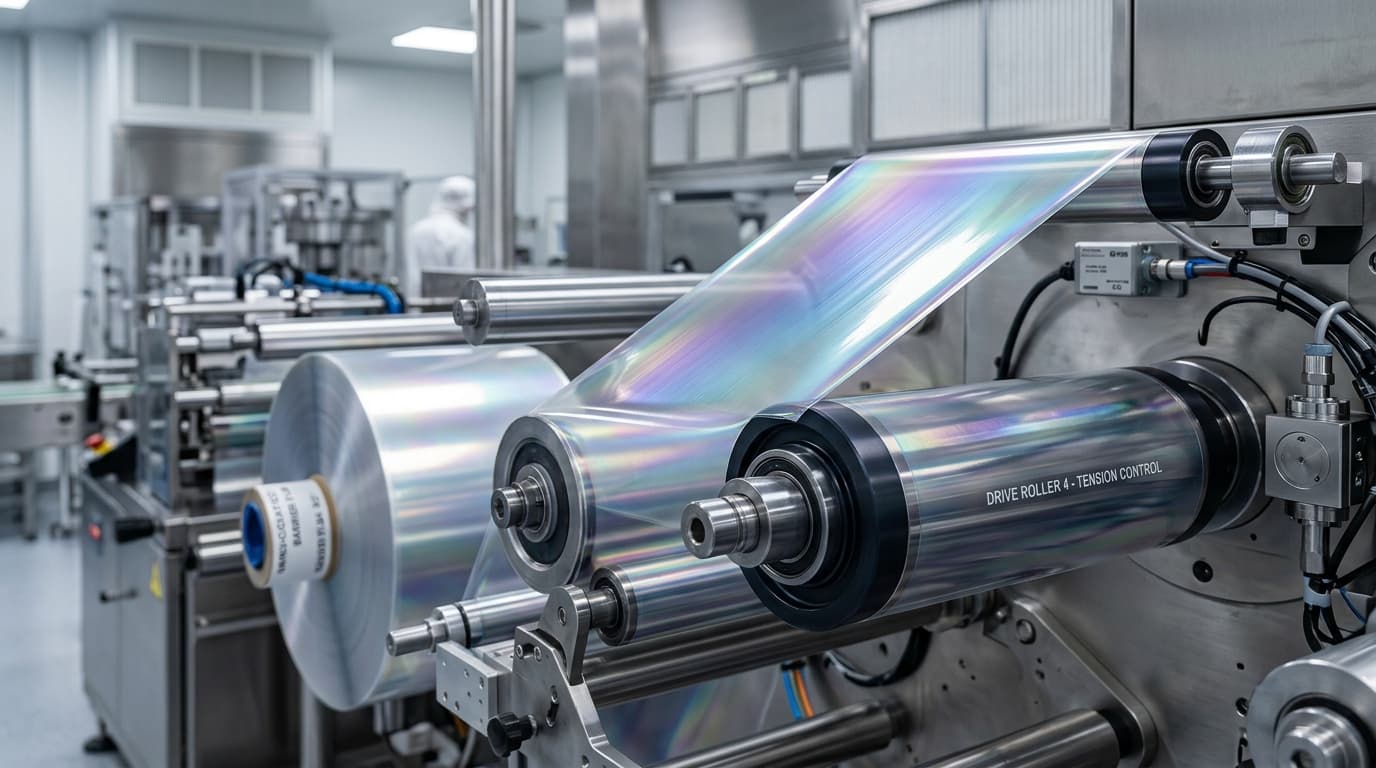
- Tension Transducer Calibration: Polyethylene retains a lower elastic modulus than PET. Calibrate unwinder brake tension and web guide dancer arms to prevent web stretching, which could fracture brittle ceramic coatings.
- Pouch Drop Testing: Drop test 50 water-filled prototype pouches from 1.5 meters flat and onto corners to verify seal bead ductility under hydraulic impact.
Summary
The transition to mono-material flexible packaging represents one of the most promising frontiers in sustainable packaging engineering. By pairing MDO orientation with vacuum barrier coatings, brands can reconcile rigorous shelf-life requirements with circular economy mandates.
Have questions about packaging materials or EPR?
Let's discuss polymer circularity, ASTM transit simulations, or pilot line trial protocols.