Navigating PCR Resin Variability in Rigid Packaging
Melt Flow Index Fluctuations, Contamination Control, and ESCR in Industrial Blow Moulding
Overview
Integrating post-consumer recycled (PCR) high-density polyethylene (HDPE) into rigid packaging lines is no longer optional for industrial chemical and FMCG manufacturers. Driven by statutory Extended Producer Responsibility (EPR) targets and corporate sustainability commitments, converting virgin container portfolios to 20–30% recycled content is an active priority across blow-moulding facilities.
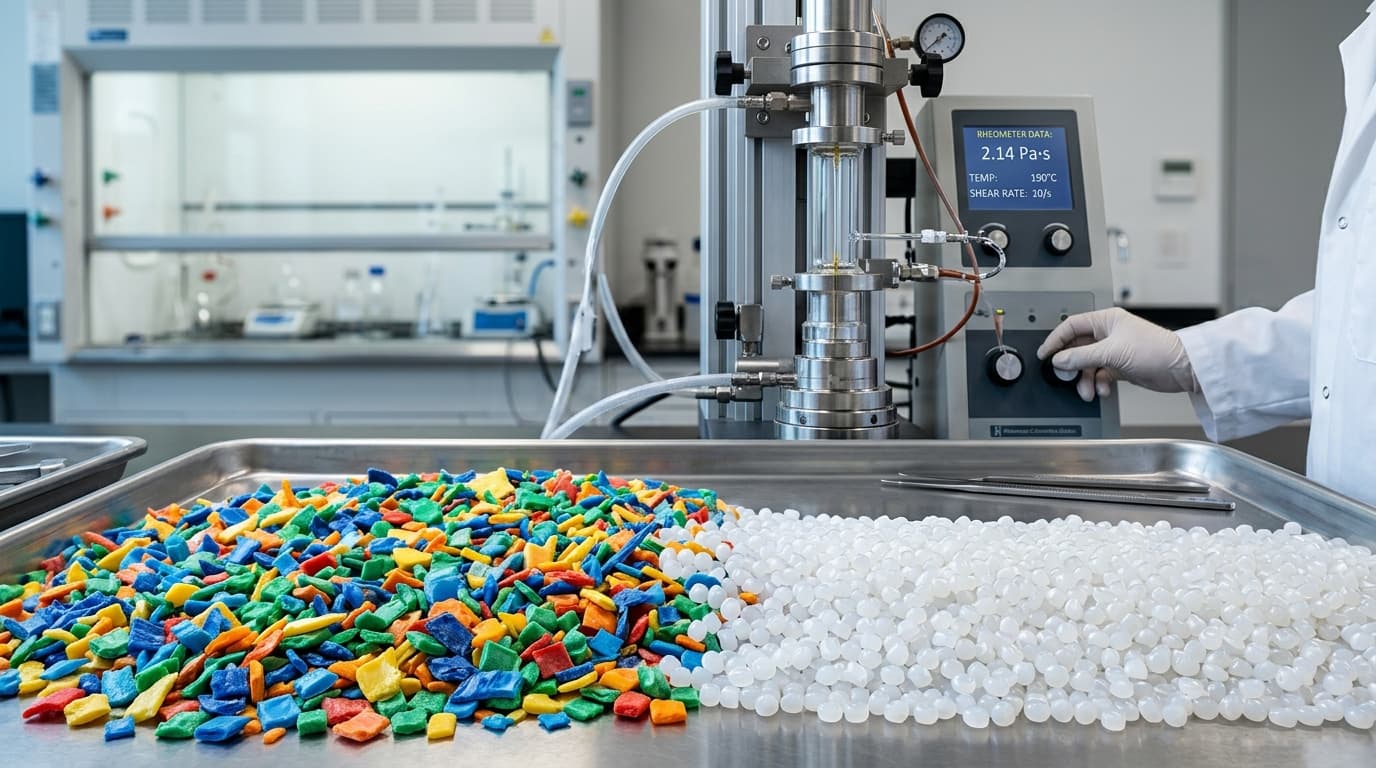
However, recycled polymer feeds do not behave like virgin resins. While virgin blow-moulding grades (such as B56003 or equivalent 0.35 MFI grades) maintain tight molecular weight distributions, PCR feeds present significant batch-to-batch variability.
This guide outlines practical qualification steps, tooling adjustments, and laboratory testing protocols necessary to run PCR HDPE without line stoppages or field leakages.
The Primary Processing Challenges
When switching a commercial blow-moulding line from 100% virgin HDPE to a PCR blend, three technical failure modes dominate:
1. Melt Flow Index (MFI) Drift and Parison Sag
Post-consumer streams typically consist of mixed recycled bottle stock. If milk bottles (injection-moulding caps and blow-moulded bodies) or personal care containers are incompletely segregated, the effective MFI of the recycled feed can fluctuate between 0.4 and 1.2 g/10 min (at 190°C/2.16 kg, ISO 1133).
- Higher MFI (>0.8) results in parison sag during the extrusion phase of Extrusion Blow Moulding (EBM). The parison elongates under its own weight before mould closure, causing severe thinning at the shoulder and top pinch-off.
- Lower MFI (<0.3) spikes extruder back-pressure and melt temperature, risking thermal degradation and volatile emissions.
2. Environmental Stress Crack Resistance (ESCR) Degradation
Environmental stress cracking is the premature brittle failure of HDPE when subjected to mechanical stress in the presence of surface-active agents (surfactants, alcohols, or aggressive construction additives).
Recycled HDPE invariably contains polymer chains that have undergone multiple thermo-mechanical history cycles, along with trace polypropylene (PP) contamination. Polypropylene inclusion creates localized phase separation boundaries within the amorphous polyethylene matrix. Under tensile load, micro-voids initiate at these PP-PE interfaces, reducing ASTM D1693 (Condition B, 10% Igepal) ESCR life by 40% to 70% compared to virgin resin.
3. Odour, Degassing, and Visual Inclusions
Volatile organic compounds (VOCs) originating from residual detergents, perfumes, and degraded pigments produce degassing bubbles inside container sidewalls. These pinhole inclusions reduce drop resistance from 1.8 meters down to less than 1.2 meters.
Engineering Solutions & Validation Protocols
Strategy A: Co-Extrusion (AB or ABA Sandwich Architecture)
Where blow-moulding machinery supports multi-layer die heads, an ABA three-layer structure isolates the PCR resin:
| Layer | Composition | Percentage Thickness | Function |
|---|---|---|---|
| Outer Layer (A) | 100% Virgin HDPE + Masterbatch | 15% – 20% | Surface gloss, print adhesion, scratch resistance |
| Core Layer (B) | 60% – 80% PCR HDPE + Virgin Carrier | 60% – 70% | Bulk structural volume, recycled content carrier |
| Inner Layer (A) | 100% Virgin HDPE (Food / Chemical Contact) | 15% – 20% | Migration barrier, chemical compatibility, ESCR shield |
By enclosing the recycled stream within virgin boundaries, direct contact between surfactants and PCR micro-voids is eliminated, preserving container ESCR to virgin parity.
Strategy B: Monolayer Compounding with Virgin Fractional-Melt Resins
For standard single-screw monolayer extruders where co-extrusion is unavailable, dry-blending PCR with a fractional-melt virgin HDPE grade (MFI 0.10 to 0.20 g/10 min) counteracts the elevated MFI of post-consumer bales:
Target MFI ~ 0.35 g/10 min
Formula: 70% Virgin (0.20 MFI) + 30% Regranulated PCR (0.75 MFI)
Adding 2% to 4% of a maleic anhydride grafted polyethylene (PE-g-MAH) or a specialized polyolefin elastomer (POE) compatibilizer bridges trace PP contamination, suppressing crack initiation at interfacial boundaries.
Shop-Floor Qualification Checklist
Before issuing production clearance for a new PCR batch, run the following verification steps:
- FTIR Spectroscopy & Differential Scanning Calorimetry (DSC): Quantify trace polypropylene content. Ensure PP contamination remains strictly below 3.5% by weight.
- Bulk Density & Moisture Check: Reject flake/pellet lots with moisture content exceeding 0.08% without prior dehumidifying hopper drying (80°C for 3 hours).
- Pinch-Off Weld Line Inspection: Section container bottoms across the flash pinch-off line. PCR requires a 5°C to 10°C increase in bottom die knife temperature to achieve complete molecular entwinement across the weld.
- Accelerated Hot-Room ESCR (50°C): Fill containers to nominal capacity with the actual target chemical formulation, torque closures to specified N·m, and hold in an environmental chamber for 21 days with weekly drop testing.
Conclusion
Successfully integrating post-consumer resins into industrial containers requires treating recycled feedstocks as engineered technical polymers rather than commodity virgin drop-ins. Through multi-layer co-extrusion or compatibilized compounding, rigid packaging can achieve 30%+ recycled targets without compromising structural integrity or transport safety.
Have questions about packaging materials or EPR?
Let's discuss polymer circularity, ASTM transit simulations, or pilot line trial protocols.